















Spider Solitaire Introduction
If you're looking for a more challenging card game, try Spider
Solitaire. It has three difficulty levels, increasing in difficulty. The beginner version (1 suit)
only requires managing one suit of cards. The intermediate version (2 suits) uses two different
suits, while the advanced version (4 suits) uses four suits and is the most difficult.
The Goal
To win the game, you must clear the tableau by creating complete
descending sequences of the same suit (from K to A). Once a sequence is completed, it is moved to
one of the eight foundation piles.
The Setup
Spider Solitaire uses 104 cards. 54 cards are placed on the
tableau, and 50 cards are in the stock pile.
Tableau:
The tableau has 54 cards, divided into ten columns, but only the last card in each column is
face up. You can arrange cards on the tableau, but only face-up cards can be moved.
Stock pile:
The stock pile contains 50 cards. If you cannot make any more moves, you can draw a face-up card
from the stock pile and place it at the bottom of each column. Therefore, the 50 cards can only
be used five times.
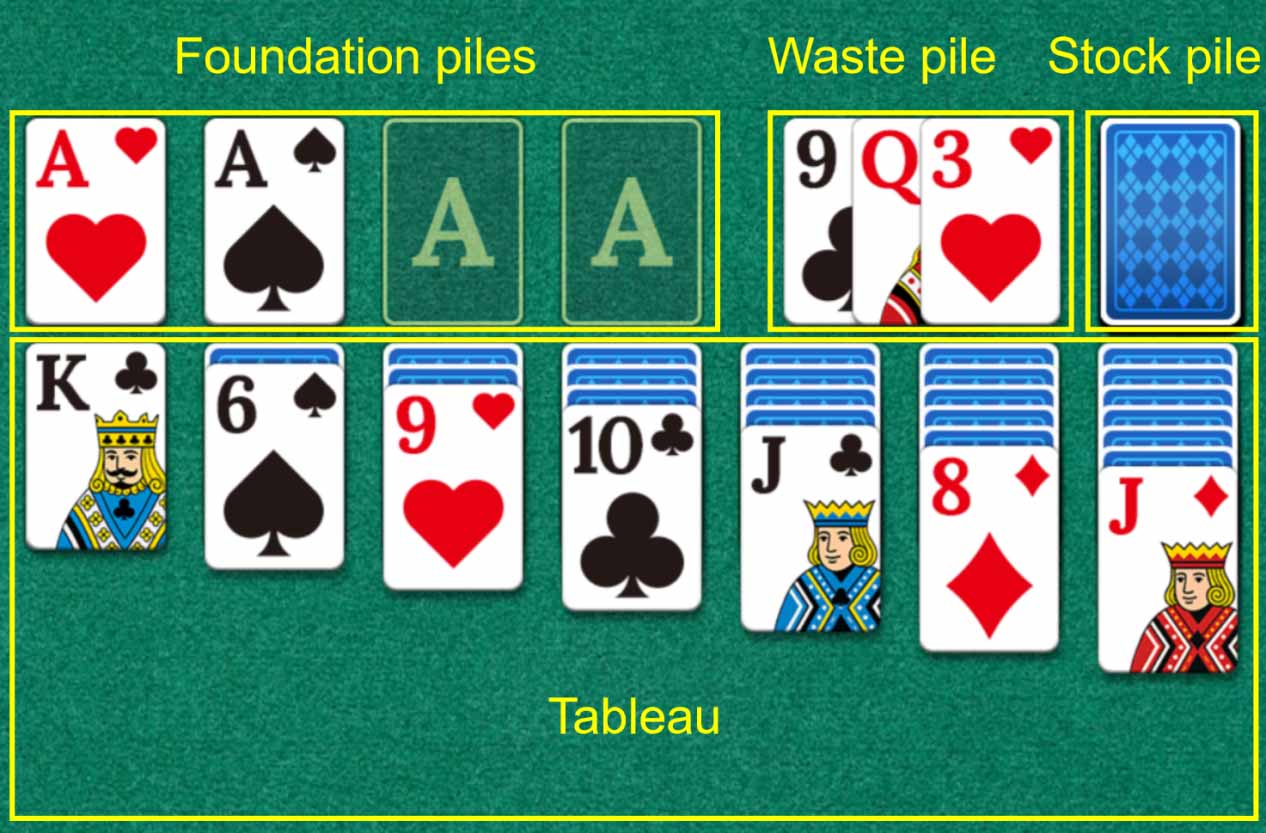
Foundation Piles:
You must create descending sequences of the same suit before you can move them to one of the
eight foundation piles.
Basic Rules of Spider Solitaire
Only face-up cards can be moved on the tableau.
You can move a face-up card onto another card that is one
rank higher.
If you uncover a face-down card, it becomes face-up and
available for play.
You can move a descending sequence of cards of the same
suit as a whole.
An empty column can accept any rank of card or a
descending sequence of cards.
If you cannot make any more moves, you can use the stock
pile to draw a new face-up card and place it at the bottom of each column.
Once you complete a descending sequence of the same suit
(from K to A) on the tableau, it is moved to the foundation pile.
Arranging Cards in Descending Order
Since you can only move complete sequences to the foundation piles, you must arrange the face-up
cards on the tableau in descending order. You can move single cards or groups of cards onto a
card of a higher rank.
For example, you can place an eight on top of a nine, or you can move a sequence from nine to
five onto a ten.
Once you move a card from a face-down card, that card will be flipped face-up, giving you
another card to use. Prioritize flipping over face-down cards to bring more cards into play.
If you clear an entire column, you can fill that empty column with any single card or group of
cards. Empty columns provide you with extra space to arrange cards.
Using the Stockpile When You Have No Moves
In Spider Solitaire, the stockpile is used differently
than in other variations. If you use the stockpile, a card is dealt to the bottom of each column.
Therefore, while you might find a useful card, it might also hinder sequences you've already built
or other possible moves.
For example, if you have a sequence from Jack to six
in a column, but you have no moves. Using the stockpile might place a useless card on top of the
six, such as a ten. You would then have to wait until you can move the ten onto the Jack to continue
the sequence. Additionally, the stockpile is limited. You have 50 cards, and once you use it five
times, your stockpile will be empty and unusable.
Moving Complete Sequences to the Foundation Piles
Only complete sequences can be moved to the foundation
piles. Therefore, once you build a complete sequence from King to Ace, you can move it to its
foundation pile. Once all eight foundation piles are complete and the tableau is empty, you win the
game.
Spider Solitaire Strategy
Use these tips to develop a winning strategy and
improve your game by trying these advanced strategies:
Focus on building sequences on higher-ranked cards.
If you try to start building sequences on higher-ranked cards like tens or nines, rather than
lower-ranked cards like fives or fours, you are more likely to build longer sequences.
Therefore, you will be using more cards, performing more actions, and turning over more
face-down cards.
Prioritize turning over face-down cards.
At the start of the game, only 10 of the 54 cards in the deck are face up. To build card
sequences, you need more options than just those 10 cards. Therefore, turning over face-down
cards provides you with more cards and allows you to complete card sequences.
Quickly clear card columns.
Since you can move any card or sequence of cards to an empty column, clearing a column frees up
more space to arrange cards. Use this to release blocked cards or rearrange the stacks.
Utilize empty columns effectively.
Before placing any card into an empty column, assess the stacks and your needs. It's usually
more beneficial to place high-ranking cards in empty columns so you can build longer sequences,
but placing a single card in an empty column can help you reveal a face-down card you might
need.
Use the deck as a last resort.
Drawing new cards sounds helpful, but the deck places a new card at the bottom of each column,
hindering sequence building and potential moves. Therefore, make sure you can't make any other
moves before accessing the deck, and remember you can only use the deck five times.
Use the undo or hint buttons if needed.
Everyone needs a little help sometimes, so when you're stuck, first use the hint button to see
if you've missed any steps. You can also use the undo button if you get stuck or find a better
move. Using these buttons can help you practice different strategies and potentially help you
win. This allows you to build longer sequences, but placing a single card in an empty column can
help you reveal a face-down card you might need.


Create an Account
Email Address
Already a member?
Log In
Last Step!
Set a password for your
account below.
Back
Password
Re-Enter Password
have send you a email
Log In
Log in to your account below
Or Continue With
Email Address
Not a member?
Create an
Account
Welcome Back

Password
forget password?
A password reset email has been sent to your inbox.